




Texas Instruments TUSB217A USB 2.0 High-Speed Signal Conditioners
Texas Instruments TUSB217A USB 2.0 High-Speed Signal Conditioners are designed to compensate both AC loss (due to capacitive load) and DC loss (due to resistive loss) in the transmission channel. The TUSB217A leverages a patented design to speed up transition edges of USB 2.0 high-speed signal with an edge booster and increases static levels with a DC boost function. The TUSB217A includes a pre-equalization function to improve the receiver sensitivity and compensate for the inter-symbol interference (ISI) jitter in applications with longer cable length. USB low-speed and full-speed signal characteristics are unchanged by the TUSB217A.
The TI TUSB217A helps a system pass the USB 2.0 high-speed near-end eye compliance with a cable as long as 5 meters. The TUSB217A is compatible with the USB On-The-Go (OTG) and battery charging (BC 1.2) protocols. The integrated BC 1.2 battery charging controller is enabled via a control pin.
Features
- Wide supply voltage range: 2.3V - 6.5V
- Ultra-low USB disconnect and shutdown power consumption
- Provides USB 2.0 high-speed signal conditioning
- Compatible with USB 2.0, OTG 2.0 and BC 1.2
- Support for low-speed, full-speed, high-speed signaling
- Integrated BC 1.2 Charging Downstream Port (CDP) and Dedicated Charging Port (DCP) controllers that dynamically changes per DCP/CDP pin
- Host/Device agnostic
- Supports up to 5-m cable length
- Four selectable signal boost (edge boost along with DC boost) settings via external pull-down resistor values
- Three selectable RX equalization settings via pull-up-or-down to compensate ISI jitter for high-loss applications
- Supports up to 10-m cable length with two TUSB217A devices
- Scalable solution - devices can be daisy-chained for high loss applications
- RWB is pin-compatible with TUSB211/212/214/216
Applications
- Laptop, desktop/docking stations
- Portable electronics
- Tablets
- Cell phones
- Televisions
- Active cable, cable extenders, backplane
Associated Eval Module

Texas Instruments TUSB217AEVM-BC Evaluation Module (EVM)
Used to evaluate the signal conditioning abilities of the TUSB217A device for various applications.
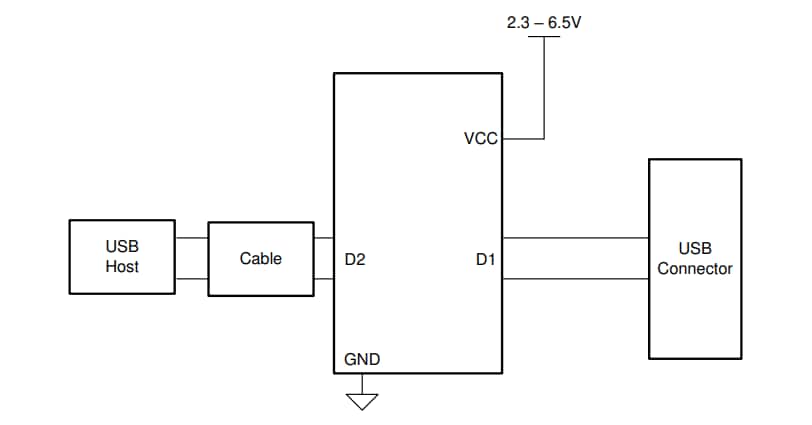
Simplified Schematic
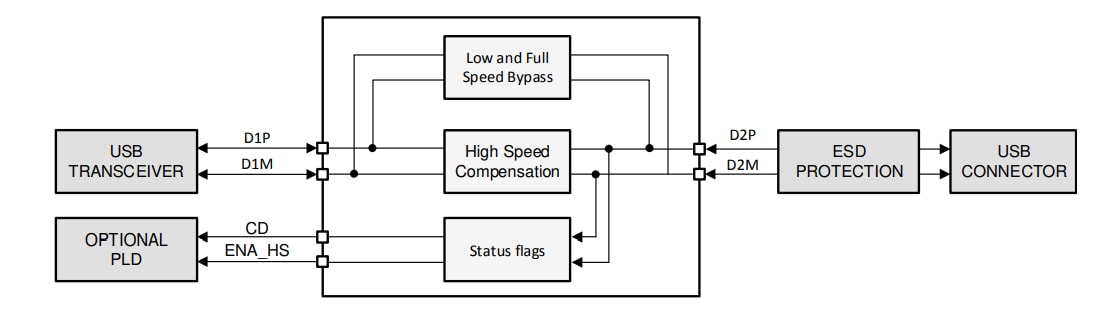
Functional Block Diagram
Publicado: 2021-07-13
| Actualizado: 2022-03-11