




Texas Instruments CC3230S/CC3230SF SimpleLink™ Wi-Fi® Wireless MCUs
Texas Instruments CC3230S/CC3230SF SimpleLink™ Wi-Fi® Wireless Microcontrollers (MCUs) provide 256KB of RAM, IoT networking security, device identity/keys, as well as MCU level security features such as file system encryption, user IP (MCU image) encryption, secure boot and debug security. The CC3230SF variant also integrates a user-dedicated 1MB of executable Flash in addition to the 256KB of RAM. These devices simplify IoT (Internet of Things) designs with a Wi-Fi CERTIFIED™ wireless microcontroller. The Texas Instruments SimpleLink Wi-Fi CC330S/CC3230SF family is a system-on-chip (SoC) solution that integrates two processors within a single chip.
Features
- Multiple-core architecture, system-on-chip (SoC)
- Multilayered security features help developers protect identities, data, and software IP
- Low-power modes for battery-powered application
- Coexistence with BLE radios (CC13x2/CC26x2)
- Network-assisted roaming
- -40°C to +85°C industrial temperature
- Wi-Fi CERTIFIED by the Wi-Fi Alliance®
- Application microcontroller subsystem
- Arm® Cortex®-M4 core at 80MHz
- User-dedicated memory
- 256KB of RAM
- Optional 1MB of executable flash
- Rich set of peripherals and timers
- 27 I/O pins with flexible multiplexing options
- UART, I2S, I2C, SPI, SD, ADC, 8-bit parallel interface
- Timers and PWM
- Wi-Fi network processor subsystem
- Wi-Fi core
- 802.11b/g/n 2.4GHz
- Modes
- Access Point (AP)
- Station (STA)
- Wi-Fi Direct®
- Security
- WEP
- WPA™/ WPA2™ PSK
- WPA2 Enterprise
- WPA3™ Personal
- Modes
- 802.11b/g/n 2.4GHz
- Internet and application protocols
- HTTPs server, mDNS, DNS-SD, DHCP
- IPv4 and IPv6 TCP/IP stack
- 16 BSD sockets (fully secured TLS v1.2 and SSL 3.0)
- Built-in power management subsystem
- Configurable low-power profiles (always, intermittent, tag)
- Advanced low-power modes
- Integrated DC/DC regulators
- Wi-Fi core
- Multilayered security features
- Separate execution environments
- Networking security
- Device identity and key
- Hardware accelerator cryptographic engines (AES, DES, SHA/MD5, CRC)
- Application-level security (encryption, authentication, access control)
- Initial secure programming
- Software tamper detection
- Secure boot
- Certificate signing request (CSR)
- Unique per device key pair
- Application throughput
- 16Mbps UDP, 13Mbps TCP
- 72Mbps peak
- Power-management subsystem
- Integrated DC/DC converters support a wide range of supply voltage:
- 2.1V to 3.6V VBAT wide-voltage mode
- VIO is always tied with VBAT
- Advanced low-power modes
- 1µA shutdown, 4.5µA hibernate
- 120µA low-power deep sleep (LPDS)
- 710µA idle connected (MCU in LPDS)
- 59mA RX traffic (MCU active)
- 223mA TX traffic (MCU active)
- Integrated DC/DC converters support a wide range of supply voltage:
- Wi-Fi TX power
- 18.0dBm at 1 DSSS
- 14.5dBm at 54 OFDM
- Wi-Fi RX sensitivity
- -96dBm at 1 DSSS
- -74.5dBm at 54 OFDM
- Clock source
- 40.0MHz crystal with internal oscillator
- 32.768kHz crystal or external RTC
- RGK package
- 64-pin, 9mm x 9mm very thin quad flat non-leaded (VQFN) package, 0.5mm pitch
- The device supports the SimpleLink MCU Platform developer's ecosystem
Applications
- For Internet of Things applications, such as
- Building and home automation
- HVAC systems and thermostats
- Video surveillance, video doorbells, and low-power camera
- Building security systems and e-locks
- Smoke detector
- Water leak detector
- Appliances
- Smart home remote control
- Asset tracking
- Factory automation
- Medical and healthcare
- CPAP
- Grid infrastructure
- Building and home automation
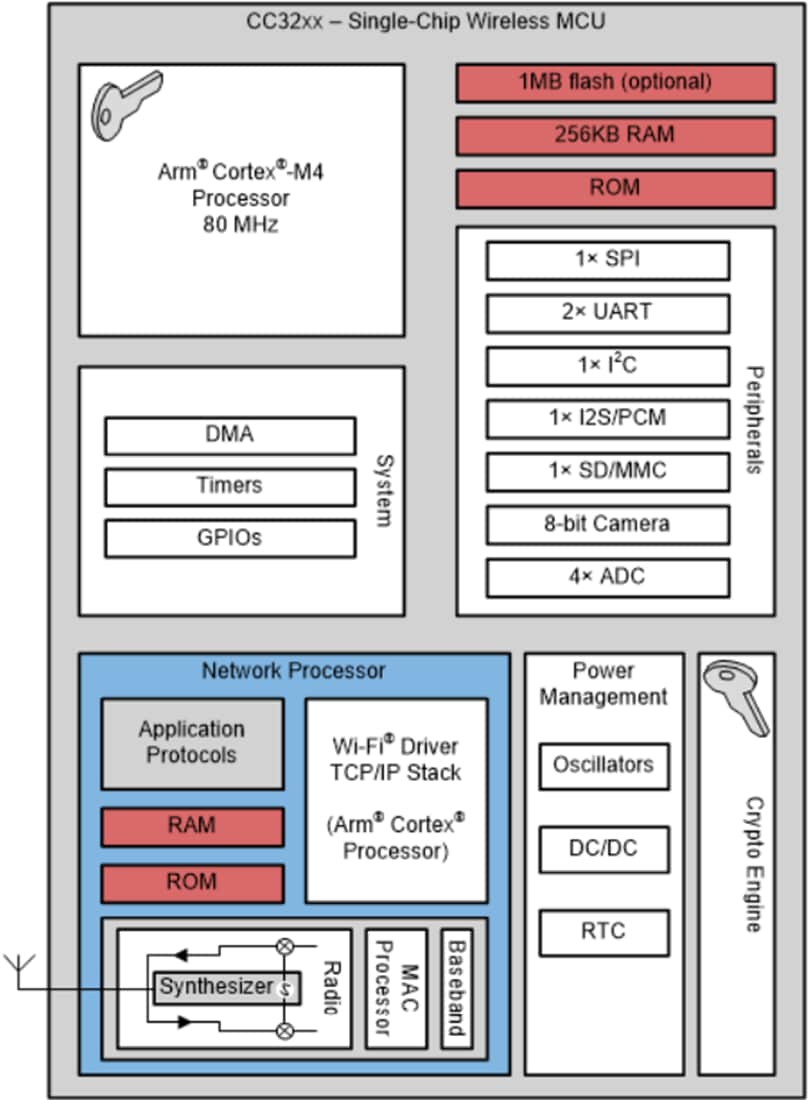
Functional Block Diagram

Hardware Overview
Related Product
Texas Instruments SimpleLink™ Microcontrollers (MCUs)
Portfolio of differentiated wired and wireless Arm® MCUs with a single development environment.
Related Development Tool

Texas Instruments LAUNCHXL-CC3235x LaunchPad™ Development Kit
A platform for evaluating the performance of the CC3235x SimpleLink™ Wi-Fi®, MCU Solution.
Publicado: 2020-08-21
| Actualizado: 2024-08-15