The Data Center Network of the Future
Automation is Key
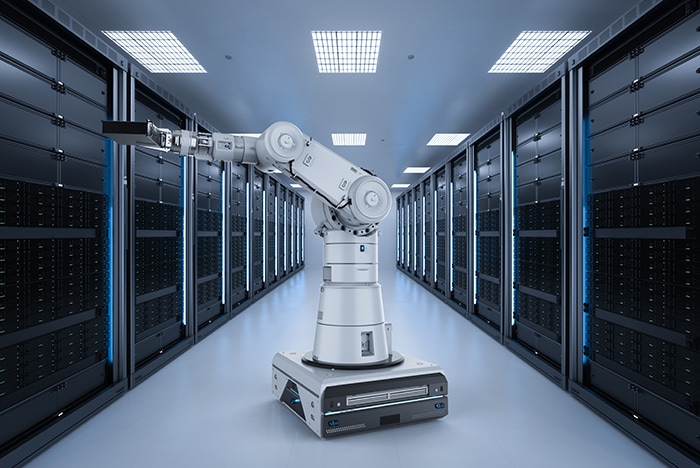
Image Source:
phonlamaiphoto/Stock.adobe.com
By Steve Taranovich for Mouser Electronics
Published May 4, 2022
Many studies predict that data centers, just within the United States, will consume close to 3000 Terawatt hours
(TWh) of electricity by the year 2030. In the coming years, rising electricity prices, coupled with high power
consumption in data centers, will lead to serious concerns related to environmental issues. Improvements in data
center-management energy efficiency will become critical for a sustainable society. Robots within the data
center may be the solution to this problem.
Today, two years after the initial COVID-19 outbreaks, business owners struggle to find workers. This is where
robots could be the future-- not designed to replace but to augment human capabilities. This will enable humans
to bring more value to other important tasks.
Timing for Useful Robots in the Data Center
Current State
Hyperscale data centers are much larger than standard data centers, taking up huge floor space (at least 930
square meters) and containing far more than 5,000 servers that run on ultra-high-speed, high-fiber networks.
Data Center human staff members conduct a plethora of functions such as checking server tags, room temperature,
underground coolant pipes, and more. Robots will take over most of these efforts shortly.
For example, Novva Data Centers deployed Boston Dynamics’ dog robots at its Utah data center to monitor its
facility tasks such as monitoring facility equipment to ensure peak efficiency and ensuring proper temperatures.
Many companies are now planning to deploy more advanced robotic systems at data centers. This effort will
ultimately need to be AI-powered, without human intervention.
The Slow Rise of Robots in the Data Center
Unlike robots and Artificial Intelligence (AI), humans are quite adaptable. Robots are not yet better at reacting
to sudden changes and cannot yet learn effectively and improve as we mere mortals do. It will still be a few
more years until robots in the data center can replace humans. Rest assured, that time is approaching very soon.
Emerging Trends in Data Center Management Automation
As we explore the automated IT processes across computing, network, and storage layers in physical and virtual
environments, it is clear that data center management and automation provide users the agility needed to act and
achieve results faster.
Intelligent monitoring systems
Data collection for mission-critical data center facilities is made possible using the internet of things (IoT)
and sensing devices. Here, information such as location, power, resource utilization, temperature, humidity, and
more can be collected and shared in real-time.
Google has already employed machine learning (ML) to improve efficiency, reduce cooling consumption, and reduce
emissions in its data centers. The company's ML algorithm reduced the energy level used for cooling by 40%, with
the lowest Power
Usage Effectiveness (PUE) indicator ever. The industry employs this measurement to measure its
efficiency in the data center. A PUE of 2.0 says that for every watt of Information Technology (IT) power,
another watt will be consumed for cooling and distributing power to IT equipment.
Practical Application of ML in the Data Center
One simple example of ML algorithms in a data center is with air conditioning which is critical in a data center.
Air temperature is set to a specific level and monitored. The environmental system will respond to temperature
changes in the data center and keep temperature to an optimum set level. (AI) and (ML) will use this data to
identify and analyze and process instructions based upon programming.
The (AI) is also responsible for energy efficiency, power management, cost reduction, accuracy, eliminating human
interface, and to meet all tasks by machine learning and artificial intelligence.
Simulation Tools with AI and Digital Twins
A digital twin is a highly complex digital representation that virtually simulates a real-life physical world
object, process, or system linked via measured data, such as power, temperature, pressure, vibration, etc. The
digital twin of a data center is a simulated 3D replica of the real-world data center (Figure
1), which will analyze the data center's current context and, in turn, recommend control actions to
improve specific parameters via a feedback loop. Digital twins often consist of the digital design tools
integrated into the real-world control of a data center.
Figure 1: The digital twin of a data center is a simulated 3D replica of the
real-world data center. (Source: Jackie Niam/Stock.Adobe.com)
Digitalization and new technologies, like digital twins and artificial intelligence, will enable industrial
companies to develop speed, efficiency, quality, and flexibility unprecedentedly.
Robotics
Robotics will replace fixed sensing devices to allow a mobile technology that will better automate processes
and/or repetitive tasks. Robots will be responsible for automating a specific function or repetitive task. These
smart machines can perform tasks that workers would typically perform, thus increasing process automation,
productivity, and reduction of human error.
Data Center robotics need to be foolproof.
Steve: “HAL, please check the data center environmental conditions."
HAL: "I'm sorry, Steve, I'm afraid I can't do that.”
An excellent example of robot tasks in the data center is the automation of asset tracking. Vision-capable mobile
robots can read LED indicators with little need for humans. The robots monitor and record measurements that are
then shared through a web-based interface.
The humans in the data center have wireless transmission capability to the robots. These robots have transponders
to find an exact location, use a low latency, and follow an efficient path. They also possess laser range
sensors and an internal motion unit, enabling them to navigate the physical data center space. The robot can
find the best trajectory while avoiding static and moving obstacles.
Another application for autonomous robots is for security purposes in data centers, where deploying 24/7, 365-day
human personnel is not feasible. The robots are loaded with multiple sensing devices, day and night cameras, and
enhanced with AI. They contain collision avoidance, fever detection technology, and facial recognition
capabilities. And with added layers of tech, the robots can communicate with humans, monitor license plates,
observe anomaly detection, and have navigation capabilities that enable automatic door and elevator usage.
Robotics-based Solution for Data Center E-Monitoring
Cloud Computing
A Cloud Robotics (CR) platform for performing environmental monitoring in data centers will enable convenient and
on-demand network access to such areas as networks, servers, storage, services, and applications.
Robot Operating System (ROS)
This is an open-source ROS that allows the creation of software for robots. This open source will provide a
complete set of tools to support common robotic problems such as path planning, collision detection, image
processing, exploration, object recognition, motion planning for arms, simulation, and machine learning (ML).
Cloud Robotics Administrator
Cloud robotics is defined as a combination of robotics and cloud computing (Figure 2). It allows
robots to benefit from modern data centers' powerful computational, storage, and communications resources.
Figure 2: Cloud Robotics. (Source: Robotics based Solution for Data Center
E-Monitoring, 2019)
Simultaneous Localization and Mapping (SLAM)
SLAM is useful for updating and building maps within unknown environments since the robot maintains information
about its location. With this method, each passive fiber connection is securely latched, with low latency, and
will be agnostic to data rates or protocols.
Robotic Fiber Switches
Hands-free automation with software can be deployed via robotic fiber switching for the physical network
connection activity. Robotic optical switches are now available and can interweave large cross-connect fabrics
while having low insertion losses and robust connections.
Due to the matrix design of the robotic optical switch, this method eliminates tangled fibers using crossbar
switching. Testing and recovery can be easily automated via a robotic fiber switch.
Next-Generation Data Center Network Enabled by Robots and Machine Learning
Deep Learning Teaches Robot its Purpose
Deep Learning has been in the machine learning field for more than 30 years. The process of teaching robots
machine learning allows engineers and scientists to decide how AI learns. Domain experts will have the next role
of advising how robots will need to function and operate within the scope of the data center task. Deep learning
focuses on the sector in which a robot needs to be specialized from its root.
The coming generation of Data Center Networks (DCN) will greatly challenge robots to be able to maximize their
performance in the data center. New DCNs will need to support cloud computing, big data, IoT,
virtualization, and above all, need to provide the scalability to handle peak times adequately for optimum
communications. Network topology will be far more complex, so human operators, who handle the management
process, will find their work tiresome and monotonous. Full data center performance will not be achievable by
only employing human operators; robots are being used now and must perform at higher levels in the
future. Artificial Intelligence and Machine Learning will play a fundamental role in managing the
complexities of bringing those processes to life.
Consider Robotics Alliance Project by NASA, for example. Some might predict that since NASA is returning to the
Moon and then on to Mars, advanced robot technology will come out of these efforts, and the efforts of other
robotics companies. NASA is just one of many embarking on bold missions. Consider the plans and breakthroughs of
Elon Musk and his ambitious strategies for getting to the moon by 2024. Data center robotics experts can learn
from these novel techniques to improve future robotic tech across all sectors.
Machine Learning (ML) and Artificial Intelligence (AI) in the Data Center
Teaching robots ML will need the assistance of engineers and scientists who will decide how AI learns. Domain
experts are the next group who will move to the next role of advising how robots need to function and operate
within the scope of any tasks. They will need to also specify the features of robots being of assistance as
logistics experts and security consultants. Deep learning focuses on the sector in which a robot needs to be
specialized at the root.
Future DCNs will need to support massive growth in the volume of traffic demanded by intelligent connected
devices and multi-tenant applications and services with incredible capabilities that meet their needs. Robots
are now and will be meeting these tasks.
This section provided an extensive branch of perception, demonstrating the applicability of proposed ML solutions
to support data center network operations and management by robots. This includes workload forecasting, traffic
control and optimization, topology management, network state prediction, failure analysis, and security.
There are many challenges ahead for ML-based solutions; however, more research is to be done, along with
re-architectured solutions that will lead to the next generation of the more intelligent, robot-assisted data
center network.
Conclusion
Indeed, automation is the key to managing the data center network of the coming future. Present-day robotic
technology for the future and more complex data center is evolving, and robot designers are incredibly
inventive. The electric vehicle manufacturing and warehouse automation sectors are advancing quickly. However, a
solid ecosystem is lacking to support robotics at infrastructure locations.
Author Bio
 Steve Taranovich is
the author of the non-fiction "Guardians of the Right stuff", a true story of the Apollo program as told by NASA
and Grumman Corp. engineers, an astronaut, and technicians. Steve was the Experienced Editor-In-Chief of
EETimes/Planet Analog and Senior Technical Editor at EDN running the Analog and Power Management Design Centers
from 2012 to 2019. He has a demonstrated history in electronic circuit design and applications for 40 years, and
9 years of technical writing and editing in industry. His specialties include Analog Electronics, Space-related
Electronics, Audio, RF & Communications, Power Management, Electrical Engineering, and Integrated Circuits (IC).
Steve Taranovich is a strong media and communications professional with a BEEE from NYU Engineering, 1972, and
an MSEE from Polytech University in 1989. From 1972 to 1988, he worked as a circuit design engineer in audio (8
years) and microwave (8 years).
Steve Taranovich is
the author of the non-fiction "Guardians of the Right stuff", a true story of the Apollo program as told by NASA
and Grumman Corp. engineers, an astronaut, and technicians. Steve was the Experienced Editor-In-Chief of
EETimes/Planet Analog and Senior Technical Editor at EDN running the Analog and Power Management Design Centers
from 2012 to 2019. He has a demonstrated history in electronic circuit design and applications for 40 years, and
9 years of technical writing and editing in industry. His specialties include Analog Electronics, Space-related
Electronics, Audio, RF & Communications, Power Management, Electrical Engineering, and Integrated Circuits (IC).
Steve Taranovich is a strong media and communications professional with a BEEE from NYU Engineering, 1972, and
an MSEE from Polytech University in 1989. From 1972 to 1988, he worked as a circuit design engineer in audio (8
years) and microwave (8 years).